Wake Forest, NC
Deck, Porch & Fence Repair in Wake Forest, NC
A lot of Wake Forest decks sit well above the ground because the lots slope away behind the houses. On an elevated deck the boards are the least important thing we look at.
Height changes the priorities
Wake Forest kept a historic core and had twenty years of subdivision building wrapped around it. In the newer half, the lots frequently slope away behind the house, which puts the rear deck well up in the air on tall posts.
On a deck two feet off the ground the boards are the main event. On one that is eight or ten feet up, the boards are the last thing we look at.
Bracing
Tall posts are slender relative to their height, and without diagonal bracing between them the whole structure can rack from side to side.
The symptom is a deck that moves noticeably when several people walk across it, or when someone leans on the rail. People tend to accept it as normal because it has always done it.
It is not normal. Sway means the lateral bracing is missing, was never adequate, or has loosened at its connections — and every time the deck racks, it works every other connection in the structure. Correcting it is usually straightforward and it is not something to leave.
Guard rails
At two feet, a railing failure is embarrassing. At ten feet it is serious, so on an elevated deck we go through it properly:
Every post by hand. Pushed firmly at the top. What moves, and where the movement is happening.
How each post is connected. A post bolted through the framing is a completely different thing from one screwed to the outside face of a rim joist. The second one relies on fasteners in shear at exactly the place they are weakest.
Rail height and baluster spacing. Older decks were built to what was normal at the time, which is not always what is expected now.
If what is there is not adequate, we will tell you plainly and tell you what it needs, rather than replacing a few boards and leaving the rail.
Post bases and footings
Tall posts concentrate load, so the base connection matters more. We look at whether the post sits on a footing or in contact with the ground, whether there is a standoff keeping it out of standing water, and whether the base connection has any corrosion.
The rest of the structure
The ledger and its flashing. Where the deck meets the house. This carries the live load of the whole deck and it is the failure that hurts people, so it is checked first regardless of what you called about.
Joist tops and board ends. Where debris and moisture collect, and where end grain drinks fastest.
Step rise across the flight. Steps that vary in height catch people out because feet learn the first one. On a long flight from an elevated deck there is more of it to get wrong.
What we take on and what we do not
Board replacement, re-decking over sound framing, railing repair, bracing, step correction and fence work are normal for us.
Structural rebuilding, anything requiring a permit or structural design, and a deck whose ledger connection has failed go to a licensed contractor. We will show you what we found and tell you what it needs. Knowing where somebody stops is worth more than a list of everything they claim to do.
Historic downtown
Around the old centre the exterior timber is a different proposition entirely: original front porches with turned balusters, moulded rail caps and columns that are part of what the house is.
Columns rot at the base. Where the column meets the porch floor, water collects and sits. The rest of the column is frequently sound while the bottom six inches has gone. A base repair or a replaced section is usually possible, and it keeps the original.
Profiles are not stocked. Balusters, rail caps and trim from that era are not sold. Individual pieces can be turned or built up to match, and normally only a handful are actually beyond saving.
Tongue-and-groove floors fail from underneath. The boards interlock so there is nothing to drain or ventilate, and the space under a roofed porch is humid and still. A board can be painted and solid-looking on top and gone below.
Replacing any of this with pressure-treated stock is visible from the street permanently, and it is the difference between a house that has been maintained and one that has been repaired.
Fences
Posts fail at ground level while looking sound above and below. Push each one along the whole run — every post went in on the same day and has had the same weather.
Where a fence is on a boundary, worth establishing whose it is before work starts.
Distance
Wake Forest is about three quarters of an hour from us, the outer edge of our area. Deck work is a multi-day booking so the drive is not a factor in the price, and there is no travel surcharge. A single small item at that distance is not good value for you and we will say so.
Getting a price
Send a wide shot, a photo from the side showing how high the deck sits, a photo of the underside showing the posts and any bracing, and a close-up of anything you are worried about. For a porch, a photo of the column bases and the floor at a low angle.
Elevated decks need bracing, and it is often missing
Where a deck sits eight or ten feet up on tall posts, diagonal bracing is what stops it swaying. On decks in Heritage, Wakefield and the developments of that generation it is sometimes absent and frequently loose at the connections.
Guard rails matter more the higher you are
Railing height, baluster spacing and the strength of every post connection are checked properly on an elevated deck. A rail that gives when leant on is a different problem at ten feet than it is at two.
Historic downtown porches are matched, not replaced
Around the old centre the porch columns, rails and balusters are profiles nobody stocks. Replacing them with pressure-treated equivalents is visible from the street for the life of the house.
Decks & Fences we have done
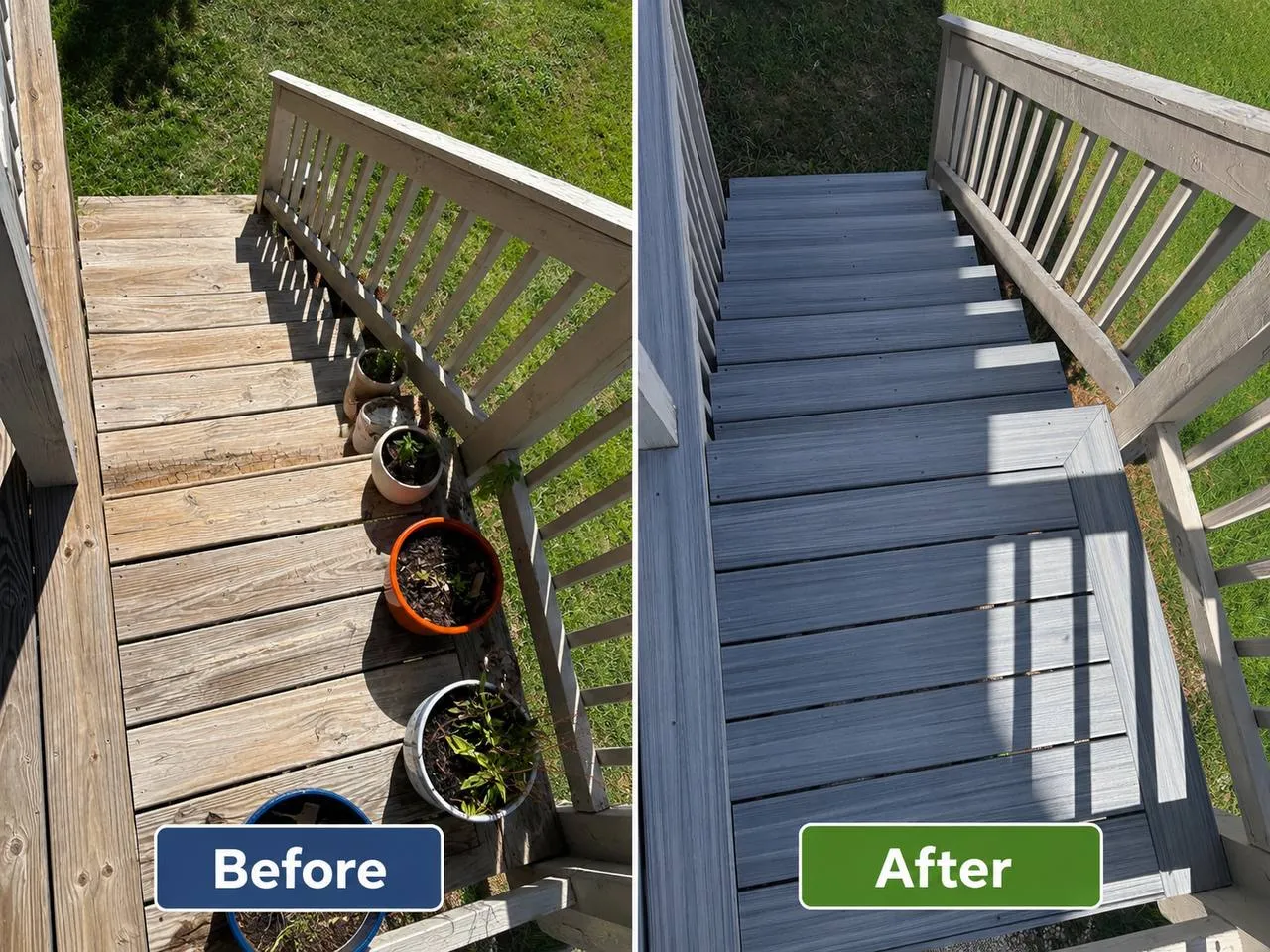
Weathered pressure-treated boards swapped for composite over framing that was still sound. The structure stayed, the surface did not.
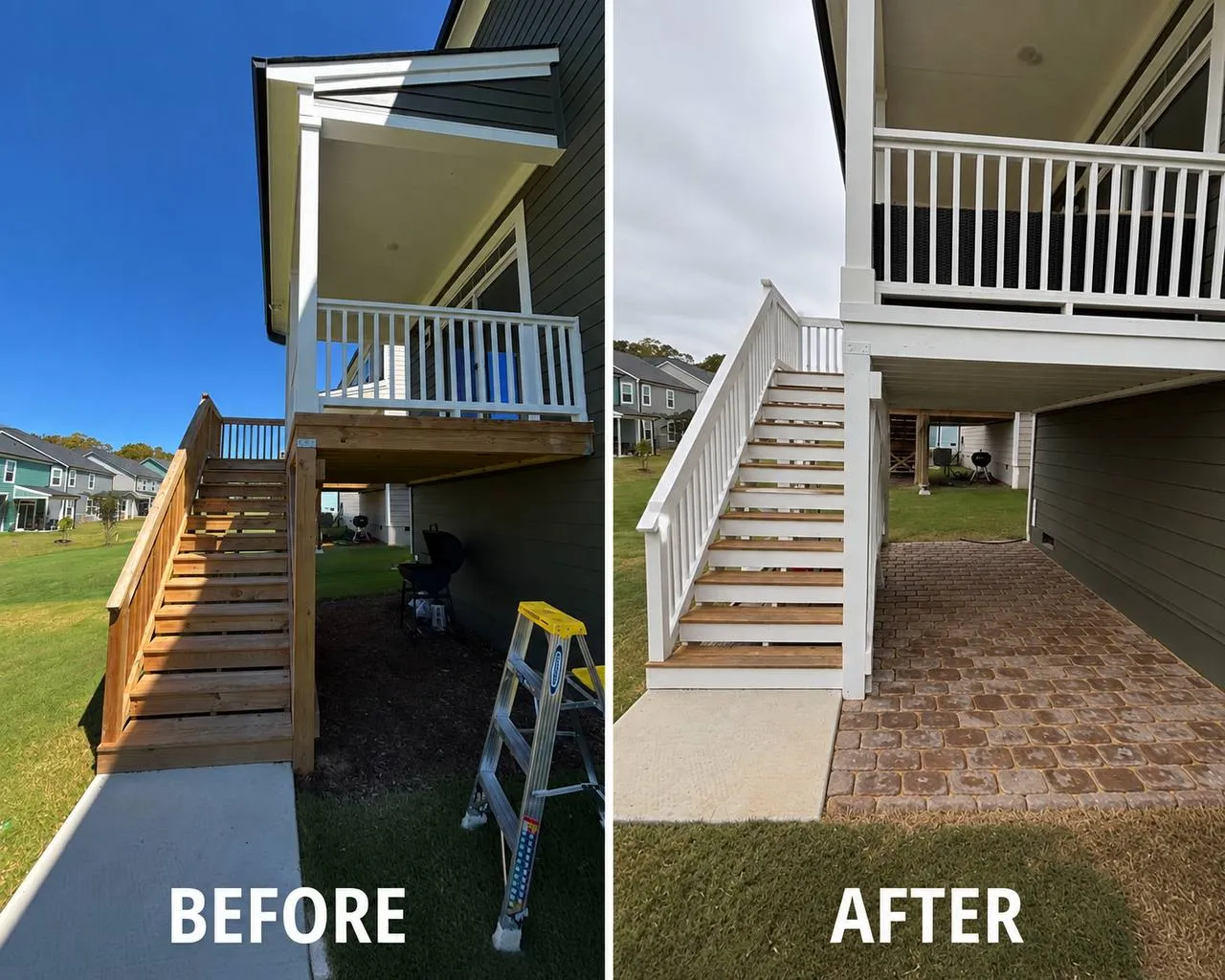
Stair and deck railings brought back to a clean white finish, and the dead strip of dirt under the deck turned into a paver patio.
Decks & Fences in Wake Forest — questions
Our deck sways slightly when people walk across it. Is that dangerous?
It is telling you something and it is worth looking at. On a deck raised on tall posts, sway means the lateral bracing is either missing, has never been adequate or has loosened at the connections. It is usually straightforward to correct and it is not something to leave, because sway loads every connection in the structure repeatedly.
How do you check whether a railing is safe?
By hand, post by post. Push each one firmly at the top and see what moves. Then look at the height of the rail, the gaps between balusters and how each post is actually connected to the frame — bolted through is very different from screwed to the side of a rim. On an elevated deck we are strict about this, and if what is there is not adequate we will tell you plainly.
Can you repair the columns on our downtown porch?
Usually. Older porch columns commonly rot at the base where they sit on the deck and water collects, while the rest of the column is sound. That base can often be repaired or a section replaced rather than swapping the whole column for a modern one. Matching costs more and it is what keeps the front of the house looking like itself.
How to get a price
- 01
Fill in the form
A sentence about the job and the address we would be coming to. Rough measurements help but are not essential — the address is the part we cannot work without.
- 02
Get a number
Most jobs are priced from the form without anyone driving out. Bigger projects get a short visit first, and the estimate is free either way.
- 03
Pick a time
The price is agreed before any work starts. We work 8am to 8pm, seven days a week, and take urgent jobs when we can.
Decks & Fences in nearby towns
Free estimate
Tell us what needs doing.
Fill in the form with a sentence about the job and the address. You get a straight price and a real window back, usually the same day you ask.