Durham, NC
Deck, Porch & Fence Repair in Durham, NC
A deck bolted onto a house built in 1925 is only as good as what it is bolted to. In Durham that connection is the first thing we look at, because it is the one failure that hurts people rather than just costing money.
The connection nobody looks at
Durham has the oldest housing stock on our list, and a great many of those houses have had a deck added to the back of them at some point in the last forty years.
That deck is bolted to the house at a ledger board, and the ledger is carrying the entire live load of the structure. It is also the single most common serious failure in residential decks anywhere, and old houses make it more likely for specific reasons.
What the ledger is fixed into. On a house built in the 1900s or 1920s, what sits behind the siding at that height varies. It may be solid framing. It may be a rim board that has been wet. It may be sheathing with very little behind it. Occasionally a deck has been fixed into masonry veneer, which is not structural and never was.
What it was fixed with. Nails, or the wrong screws, or lag bolts that were adequate when the deck was new and have since corroded in a wet joint.
Whether it was flashed. This is the big one. Without flashing above the ledger, water runs down the wall, gets behind the ledger and sits there against the framing of the house. That rots the ledger and the house framing behind it at the same time, out of sight, for years.
So on any older Durham property the ledger gets assessed before anything else is discussed. If it is sound, the rest is a normal repair conversation. If it is not, that is the conversation, and it may well be work for a licensed contractor rather than for us.
Front porches are a different animal
Durham is a porch town, particularly in Trinity Park, Old North Durham, Watts-Hillandale and the mill streets. Those porches are original, they are part of what the house is, and they are built nothing like a modern deck.
Tongue-and-groove flooring. The boards interlock rather than sitting apart with a gap. That looks better, it is historically right, and it means there is nowhere for water to drain and no air movement to dry the underside.
A roof over it. Which keeps rain off the surface but does nothing about humidity, and creates a sheltered, still, unventilated space beneath the floor.
Put those together and you get the characteristic porch failure: a board that is painted and sound-looking on top and gone underneath. People go through porch floors with no warning at all, because there was never any warning to see.
Which is why the assessment starts underneath. Where there is access, we get under and probe the joists and the underside of the flooring. Where there is not, we lift a board.
Repairing a tongue-and-groove floor is more involved than replacing a gapped deck board, because the boards interlock — you cannot simply lift one out of the middle. That is worth knowing before assuming it is a quick job. It is entirely doable, and it takes longer.
Matching, not replacing
The other thing about original porches is that everything on them is a profile that is no longer sold.
Turned balusters, the rail and cap profiles, the column bases, the beadboard on a porch ceiling. Replacing any of that with pressure-treated stock from a merchant is what makes a house look repaired rather than maintained, and it is visible from the street forever.
Usually only a handful of pieces are actually gone. Individual balusters can be turned or built up to match. Rail sections can be milled or assembled from parts. It costs more than a stock replacement and it is the difference between a repair and a downgrade.
We will tell you honestly when a piece is beyond saving and when it just looks it.
The newer south side
Woodcroft, South Durham and the newer building toward the I-40 corridor have decks of a recent generation. Those are ordinary work: boards, fasteners, railings, and a ledger that was flashed properly when it went in.
The common jobs there are boards that have cupped or split, fasteners standing proud, and railings that have loosened at the post.
What always gets checked
Whatever you called about, the same survey:
- The ledger and its flashing, first
- Post bases where they meet footings or ground
- Joist tops, where debris holds moisture under the decking
- Board ends, because end grain goes first
- Every railing post by hand
Where we stop
Structural rebuilding, anything needing a permit, and a deck whose ledger connection has failed are not handyman work. We will show you what we found and tell you what it needs. Knowing where somebody stops is worth more than a list of everything they claim to do.
Getting a price
Send a wide shot, a close-up of the worst area, and — the useful one — a photo from underneath if you can safely get there. For a porch, a photo of the flooring taken at a low angle so we can see the joint lines. Tell us roughly when the deck or porch was built.
Durham is about thirty-five minutes from us, with no travel surcharge.
Decks added to old houses have suspect ledger connections
Where a deck was added to a 1900s or 1920s house decades later, the ledger may be fixed into a rim board, into a masonry veneer, or into framing that has since been wet. That connection carries the entire live load of the deck and it is checked before anything else.
Front porches are older than the decks and built differently
Durham has a lot of original front porches with tongue-and-groove flooring, turned posts and rails that are part of the character of the house. Those are repaired and matched, not replaced with pressure-treated stock.
Porch floors rot from underneath in a way decks do not
A roofed porch keeps rain off the surface but traps humidity below it, and tongue-and-groove boards have no gaps to drain or dry. The failure is on the hidden face, which is why a porch floor can give way with no warning from above.
Decks & Fences we have done
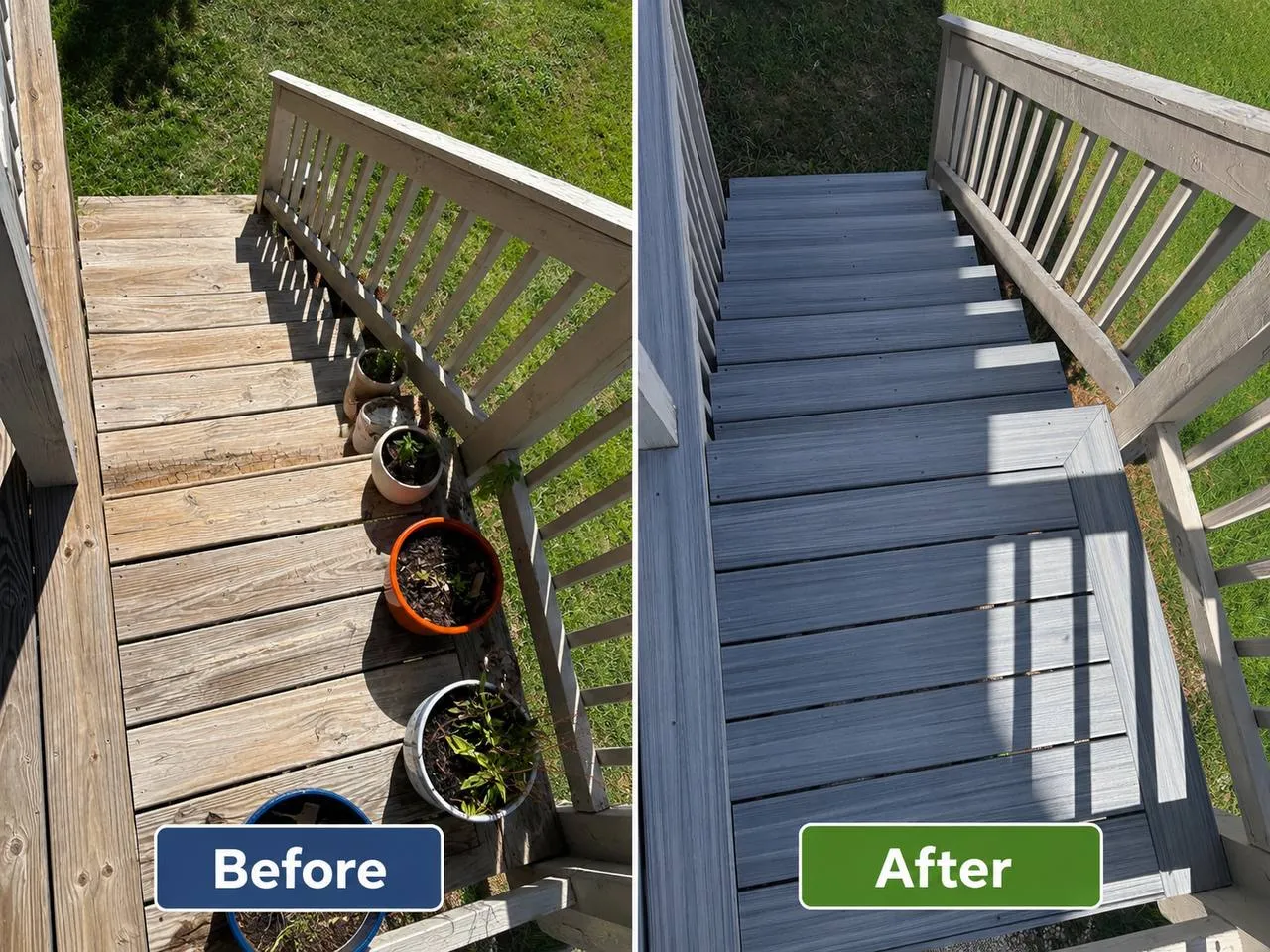
Weathered pressure-treated boards swapped for composite over framing that was still sound. The structure stayed, the surface did not.
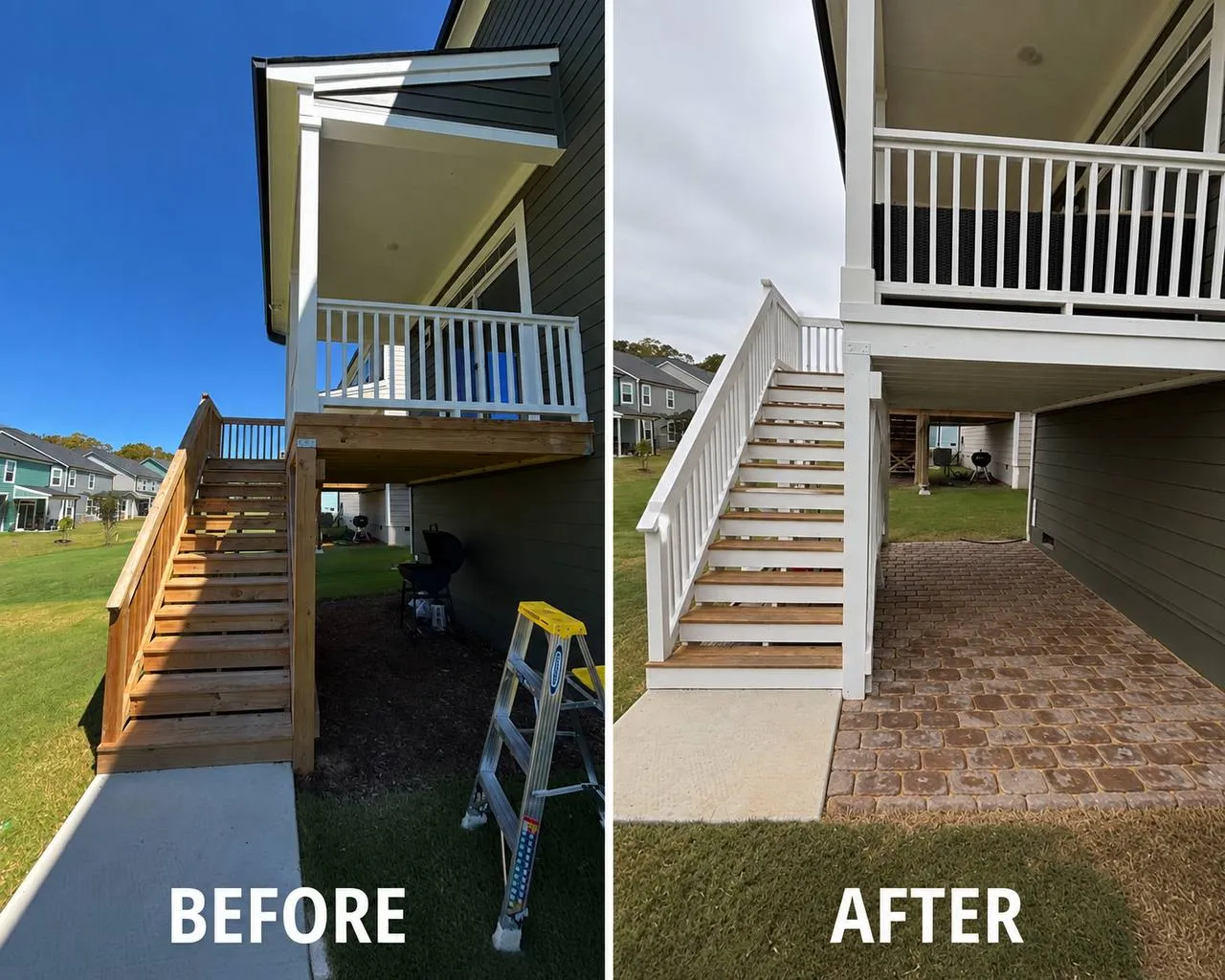
Stair and deck railings brought back to a clean white finish, and the dead strip of dirt under the deck turned into a paver patio.
Decks & Fences in Durham — questions
How do we know if the deck is safely attached to the house?
It is checked at the ledger — the board bolted to the house that everything hangs from. We look at what it is fixed into, what fixings were used, whether there is flashing above it, and whether the framing behind it is sound. If any of that is wrong the deck can look perfectly fine and still be the most dangerous thing on the property, so it is the first thing we assess.
Our porch board gave way with no warning. Why did nothing show?
Because tongue-and-groove porch flooring fails from underneath. The boards interlock so there are no gaps for water to drain or air to dry, and the underside sits in a humid, unventilated space. The top face can look sound and painted while the bottom two thirds of the board has gone. It is the reason we look under a porch rather than just at it.
Can you match the railings on our old front porch?
Usually. Turned balusters and older rail profiles are not stocked, but individual pieces can often be turned or built up to match, and frequently only a few are actually gone. Replacing an original porch rail with pressure-treated stock is what makes a house look repaired rather than maintained, and we would rather match it.
How to get a price
- 01
Fill in the form
A sentence about the job and the address we would be coming to. Rough measurements help but are not essential — the address is the part we cannot work without.
- 02
Get a number
Most jobs are priced from the form without anyone driving out. Bigger projects get a short visit first, and the estimate is free either way.
- 03
Pick a time
The price is agreed before any work starts. We work 8am to 8pm, seven days a week, and take urgent jobs when we can.
Decks & Fences in nearby towns
Free estimate
Tell us what needs doing.
Fill in the form with a sentence about the job and the address. You get a straight price and a real window back, usually the same day you ask.