Garner, NC
Deck, Porch & Fence Repair in Garner, NC
A lot of Garner decks were built in the nineties, which puts them at the age where the decision is no longer whether to replace a board. It is whether the frame underneath is worth keeping.
The decision a nineties deck forces
Garner has a large stock of 1960s to 1980s ranches and split-levels, and a great many of them had a deck added in the 1990s. Thirty years on, those decks arrive at a specific decision point.
The boards have usually gone first — they are thinner, they are exposed on both faces, and they take the weather. The frame underneath is heavier timber, more of it is shaded by the decking, and it often survives considerably longer.
So the question is not whether to replace boards. It is whether the frame has another fifteen years in it.
If it does, re-decking over the existing structure is very good value. The frame is the expensive part of a deck — the posts, the footings, the beam, the joists, the ledger. Keeping it and putting a new surface on costs a fraction of a full rebuild.
If it does not, replacing the boards is money spent on top of a structure that will need doing anyway.
That is a real decision with a real price difference, and it deserves an honest answer rather than a guess.
How we find out
Not by looking. Thirty-year-old pressure-treated timber looks grey and rough whether it is sound or not.
The test is an awl or a screwdriver pressed into the timber at the points that fail first:
- The tops of joists, under the decking, where debris and moisture collect
- Joist ends, at the ledger and at the rim
- The beam, particularly where posts meet it
- Post bases, at footings or ground level
- The ledger itself, and the framing behind it if there is any access
Sound timber resists the point. Failed timber takes it easily and comes away in fibres.
Doing that across a deck properly takes half an hour, and it is what makes the difference between a quote you can rely on and one that changes on day two.
Decks that sit too low
This is a Garner-specific issue and it is worth understanding.
Ranch houses sit low to the ground, and decks built onto them frequently sit low too — sometimes with only a few inches of clearance underneath.
That space is a problem:
- No airflow. Nothing dries.
- It collects debris. Leaves blow in and cannot be swept out, then hold water against the joists indefinitely.
- It is inaccessible. Which is why nobody has ever cleared it.
The result is a deck that rots from below while looking acceptable from above, and where the joist tops and the underside of the decking are the worst-affected parts of the whole structure.
Where we can get in and clear it, that alone extends the life of the deck considerably. Where the clearance is too tight, improving drainage away from the area and removing what can be reached at the edges still helps.
The ledger, and the era it was built in
Flashing above a deck ledger — a metal detail that stops water running down the wall and getting behind the board — was not universal practice when many of these decks were built.
Without it, water has been running behind the ledger and sitting against the framing of the house for thirty years. That rots the ledger and the house structure behind it simultaneously, entirely out of sight.
So on any deck of this age the ledger is the first thing assessed. If it is sound and flashed, everything else is a normal repair conversation. If it is not, that becomes the conversation, and depending on what we find it may be work for a licensed contractor rather than for us. We will show you what is there and say so plainly.
Railings, steps and porches
Railings. Every post checked by hand. A railing that gives when leant on is a safety issue, not a cosmetic one, and railing posts of this age are frequently loose at the connection.
Steps. Rise measured across the whole flight. Steps that vary in height are a genuine cause of falls, because your feet learn the first one and expect the rest to match.
Porches. Where a Garner house has a covered porch, the flooring may be tongue-and-groove, which has no gaps to drain and no airflow underneath. Those fail on the hidden face and give way without warning from above.
Fences
Posts rot at ground level while looking fine above and below it. Push each one — a failed post moves at grade with very little effort. Every post in a run was installed the same day, so if one has gone it is worth checking the rest.
Getting a price
Send a wide shot of the whole deck, a close-up of the worst area, a photo taken from the side showing how much clearance there is underneath, and a photo of where the deck meets the house if you can get one.
Tell us roughly when it was built. In Garner that answer alone tells us a lot about what we are going to find.
Garner is about half an hour from us, in the same bracket as most of our list.
Nineties decks are at the frame-or-surface decision
A pressure-treated deck of that vintage has usually had its boards go first while the framing survived. Whether that framing has another fifteen years in it is the question that decides whether you spend a little or a lot, and it is answered by probing rather than by looking.
Low decks close to grade never dry underneath
Ranch homes sit low, so their decks often sit low too — sometimes with very little clearance to the ground. That space stays damp, gets no airflow and collects leaves, and the joists above it rot from the top and the bottom at once.
Older ledger details are the thing to check first
Flashing above a ledger was not universal practice when many of these decks went up. Without it, water has been running behind the ledger and into the house framing for thirty years.
Decks & Fences we have done
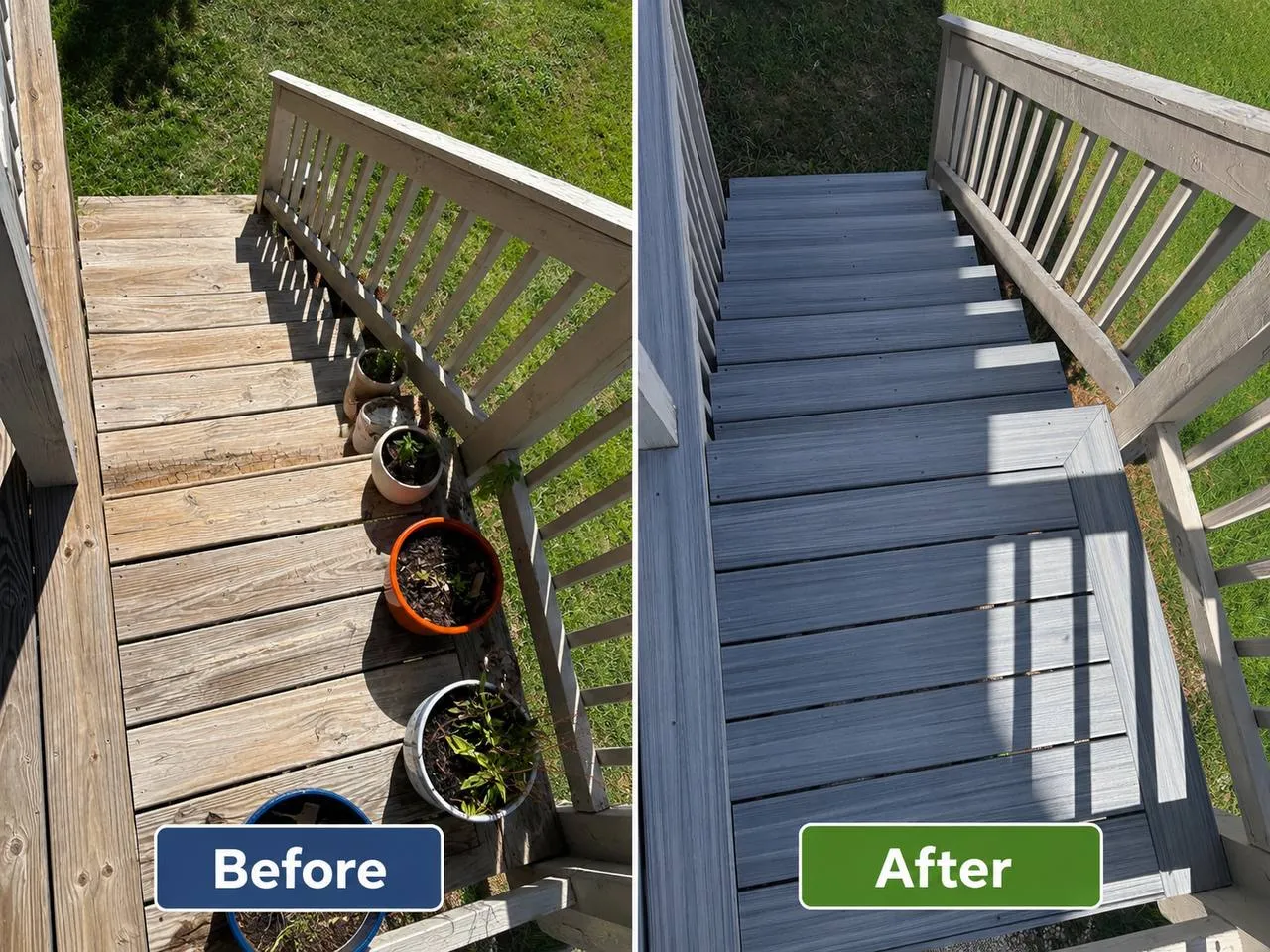
Weathered pressure-treated boards swapped for composite over framing that was still sound. The structure stayed, the surface did not.
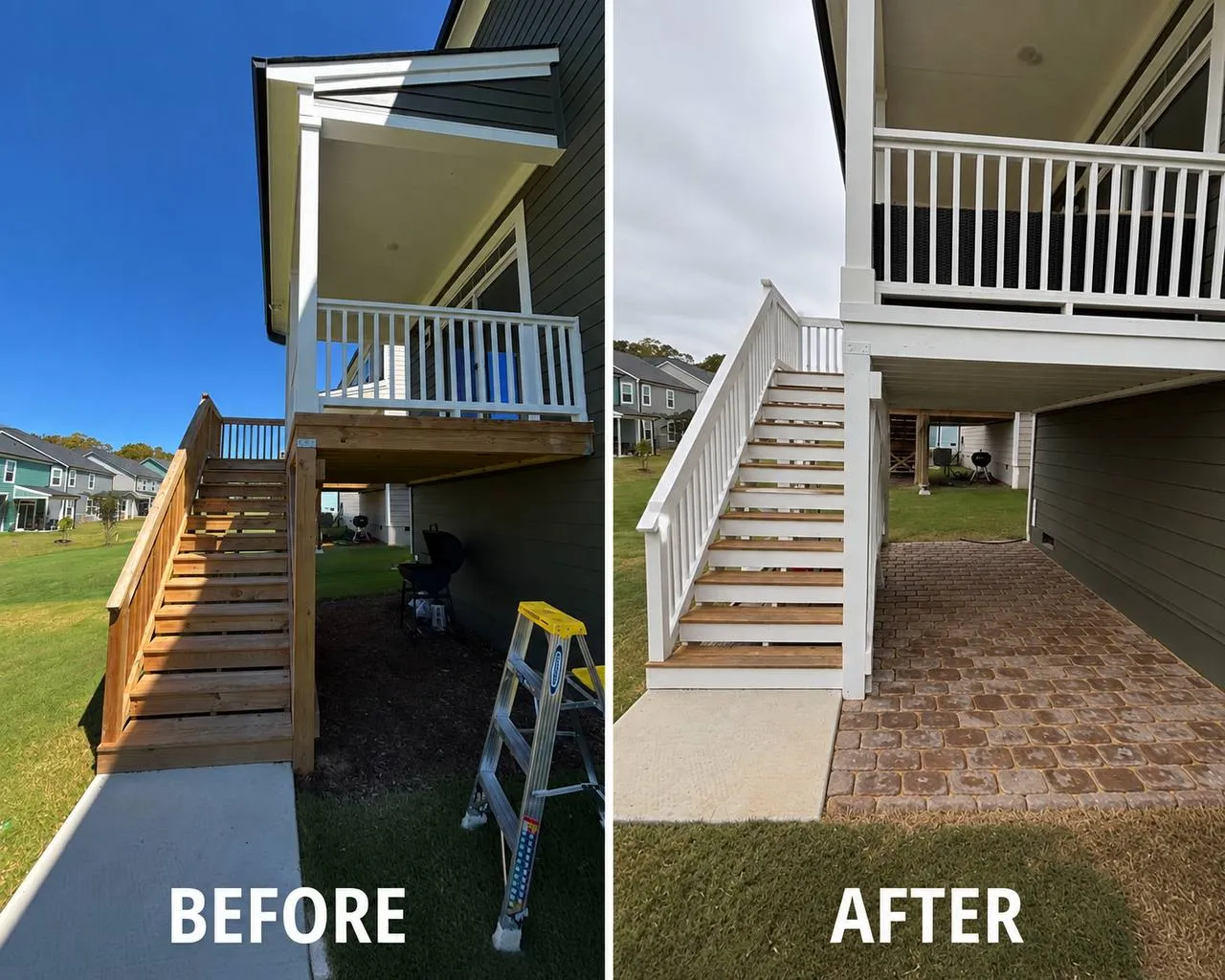
Stair and deck railings brought back to a clean white finish, and the dead strip of dirt under the deck turned into a paver patio.
Decks & Fences in Garner — questions
Our deck boards are shot. Is it cheaper to re-deck or replace the whole thing?
Re-decking is far cheaper if the frame is sound, because the frame is the expensive part. The honest way to find out is to probe the joists, the beam, the posts and the ledger with an awl rather than to look at them. If the structure resists, you are looking at a surface job. If it does not, replacing boards over failing framing is money thrown away.
There is almost no space under our deck. Does that matter?
It matters a lot. A deck sitting close to the ground gets no airflow underneath, and the space fills with leaves that hold moisture against the joists. Those decks rot from below while looking fine from above. Where we can, clearing the space and improving drainage extends their life considerably.
How do we know the deck is safely attached to the house?
By looking at the ledger — the board bolted to the house that everything hangs from — and at whether there is flashing above it. Flashing was not standard practice on every deck of this age. Without it, water has been getting behind the ledger for decades and rotting both the ledger and the house framing behind it. It is the first thing we check.
How to get a price
- 01
Fill in the form
A sentence about the job and the address we would be coming to. Rough measurements help but are not essential — the address is the part we cannot work without.
- 02
Get a number
Most jobs are priced from the form without anyone driving out. Bigger projects get a short visit first, and the estimate is free either way.
- 03
Pick a time
The price is agreed before any work starts. We work 8am to 8pm, seven days a week, and take urgent jobs when we can.
Decks & Fences in nearby towns
Free estimate
Tell us what needs doing.
Fill in the form with a sentence about the job and the address. You get a straight price and a real window back, usually the same day you ask.