Chapel Hill, NC
Deck, Porch & Fence Repair in Chapel Hill, NC
A deck in an open subdivision dries out between rain showers. A deck under a Chapel Hill canopy does not, and that single difference means the boards here fail years earlier and from underneath rather than on top.
Why Chapel Hill decks fail differently
Chapel Hill is wooded in a way most of the Triangle is not, and for exterior timber that is the whole story.
An exposed deck in an open subdivision gets wet and then dries, repeatedly. The damage that eventually accumulates is mostly ultraviolet and thermal — surface fibres breaking down, boards cupping and splitting, fasteners working loose as the timber moves.
A deck under a mature canopy barely dries at all. It stays wet for days after rain, and through the winter it may not get a properly dry week from November to March. Add leaf litter sitting in the gaps and on the joists, and the timber is held in contact with moisture more or less permanently.
The result is rot rather than weathering: soft boards, spongy ends, and framing that can be in poor condition while the surface still looks acceptable.
Where it starts
Water does its damage where it sits longest, which is rarely where you are looking.
Board ends. End grain drinks water far faster than the face of a board. The ends over the rim joist, and either side of a butt joint, go first.
The tops of joists. Debris collects on the horizontal surface under the decking, holds water against the joist and against the underside of the boards. That is the single most common place for a deck to be failing invisibly.
Post bases. Where a post meets a footing or the ground, particularly if soil or mulch has crept up against it.
Under the ledger. Where the deck attaches to the house. If flashing is missing or has failed, water tracks behind it and into the framing of the building itself, which is a considerably more serious problem than a soft deck board.
How we actually check
Looking is not much use. Colour and algae tell you very little — plenty of green-looking boards are solid and plenty of clean ones are not.
The test is mechanical. A screwdriver or an awl pressed into the timber at the vulnerable points: board ends, over each joist, at post bases, at the ledger. Sound timber resists the point. Rotten timber takes it with almost no pressure and comes away as fibres rather than chips.
Doing that across a deck takes twenty minutes and it is what separates a real assessment from a guess. It is also the difference between quoting a board replacement and discovering on day two that the framing has gone.
Three outcomes
Boards and fasteners only. The framing is sound and the decking has suffered. Individual boards get replaced or the whole surface gets re-decked over the existing structure. This is the common case and it is good value, because the expensive part of a deck is the frame.
Framing repairs. Individual joists, a rim, or a post replaced while the rest of the structure carries on. Normal work, and it is worth doing before it spreads.
Beyond a repair. Where the framing is widely gone, or the ledger connection to the house is compromised, this stops being handyman work. Structural rebuilding and anything needing a permit goes to a licensed contractor, and we will tell you that plainly rather than patch a deck that should not be walked on.
Porches
Chapel Hill has a lot of covered porches, and they fail differently again. A roof keeps the rain off the floor but does nothing about humidity, and the shaded, sheltered, poorly ventilated space underneath a porch floor is ideal for rot.
Tongue-and-groove porch flooring is particularly vulnerable because the joints hold water and there is nowhere for it to escape. Replacing individual boards in a tongue-and-groove floor is more involved than in a gapped deck, since the boards interlock — it is worth knowing that before assuming it is a quick fix.
Fences and railings
Fence posts on a shaded lot rot at ground level for the same reasons, and the giveaway is a panel that has started to lean while looking otherwise fine. The post is usually gone below grade before anything shows above it.
Railings are worth checking separately from the deck itself, because a railing that has loosened at the post connection is a safety issue rather than a cosmetic one. We check every post by hand.
Maintenance that actually helps here
Cleaning and sealing is the standard advice and on a shaded lot it is only half the answer. Sealing a deck that is already holding moisture traps it.
What genuinely helps in Chapel Hill:
- Clearing debris out of the gaps between boards, which is where it packs down and holds water against the joists
- Sweeping the joist tops where the decking is open enough to reach
- Keeping mulch and soil away from post bases
- Cutting back what is overhanging, where that is possible, so the deck gets some drying time
That is unglamorous work and it extends the life of a deck here more than any coating.
Getting a price
Send a wide shot of the whole deck, a close-up of the worst board, and — the important one — a photo of the underside if you can safely get to it. Also tell us how old it is and whether anything has been done to it before.
Chapel Hill is about thirty-five minutes from us, with no travel surcharge.
Shade means rot, not sun damage
Under mature tree cover a deck stays wet for days after rain and never fully dries in winter. The failure mode is biological — soft boards, spongy ends, algae on the surface — rather than the splitting and cupping you get on an exposed deck.
The damage starts where you cannot see it
Board ends, the tops of joists where debris collects, and the underside of the decking go first because that is where water sits longest. A board can look acceptable from above and be gone underneath.
Leaf litter is a structural problem, not an appearance one
Debris packed into the gaps between boards and sitting on top of joists holds water permanently against the timber. Clearing those gaps out does more for a Chapel Hill deck than any coating.
Decks & Fences we have done
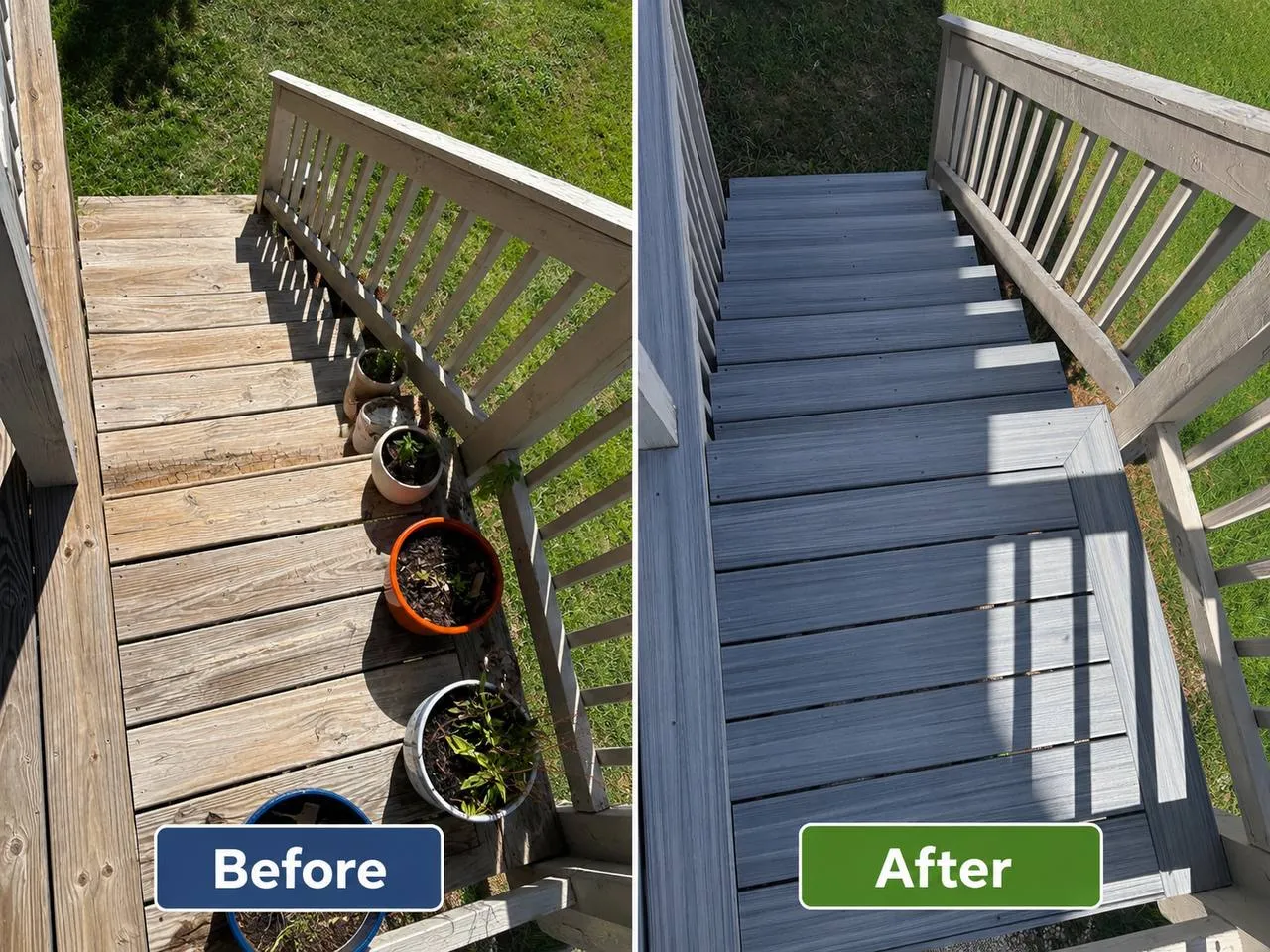
Weathered pressure-treated boards swapped for composite over framing that was still sound. The structure stayed, the surface did not.
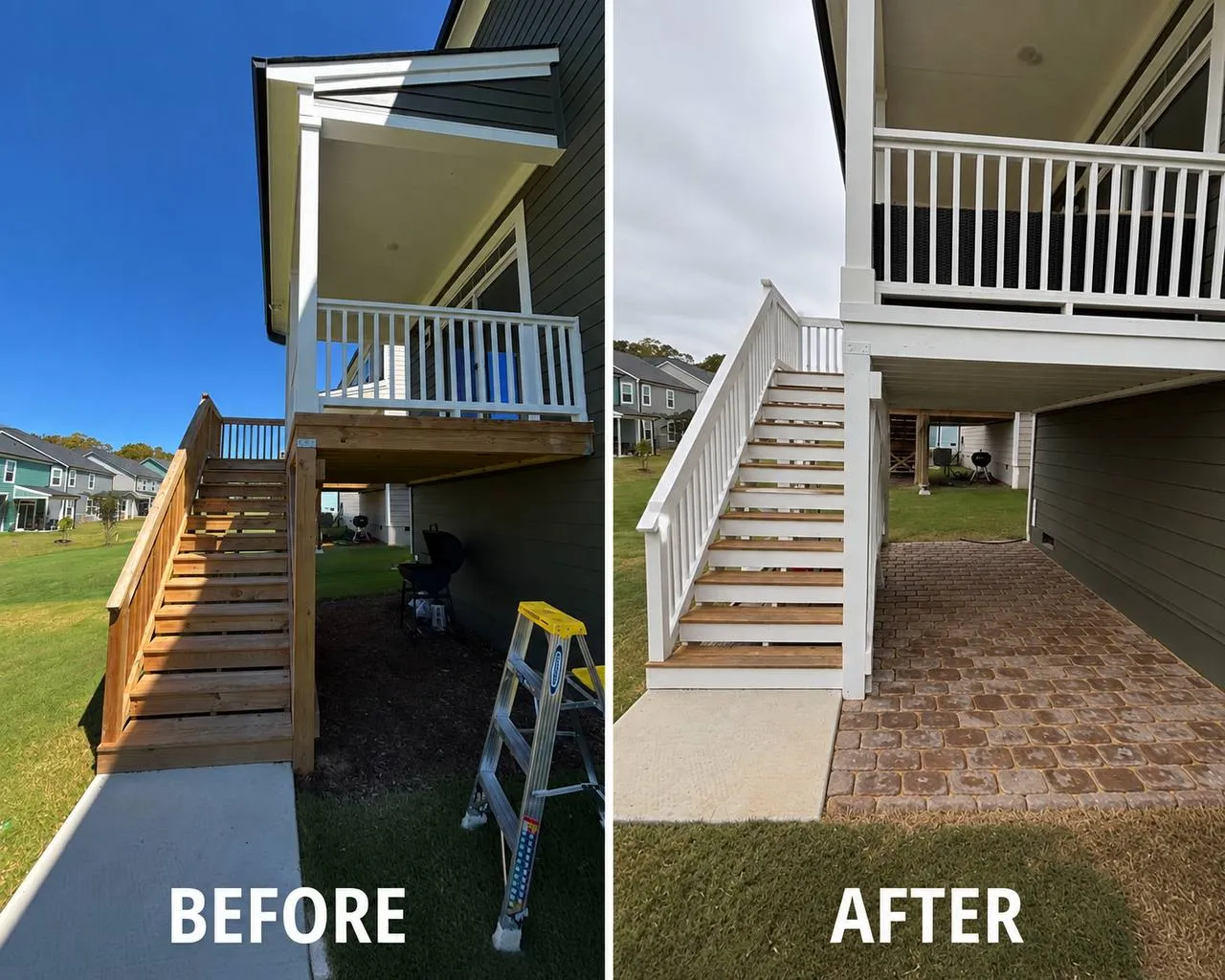
Stair and deck railings brought back to a clean white finish, and the dead strip of dirt under the deck turned into a paver patio.
Decks & Fences in Chapel Hill — questions
Our deck is always damp and green. Is that a repair or a replacement?
It depends how far it has gone, and the honest way to find out is to probe rather than to look. If the joists and posts are still sound and only the boards have suffered, it is a board-and-fastener job. If a screwdriver goes into the framing without much resistance, that is a bigger project and we will show you what we found before quoting it.
How do you tell whether a board is actually rotten?
Press a screwdriver or an awl into it, particularly at the ends and where it sits over a joist. Sound timber resists; rotten timber takes the point with almost no pressure and comes away in fibres. Colour and algae tell you very little on their own — plenty of green-looking boards are perfectly solid and plenty of clean ones are not.
Would cleaning and sealing it help?
It helps a sound deck and it does nothing for one that is already soft. On a shaded lot the more useful work is usually mechanical: clearing debris out of the board gaps, off the joist tops and away from the post bases so the timber has a chance to dry. A coating over trapped moisture makes things worse rather than better.
How to get a price
- 01
Fill in the form
A sentence about the job and the address we would be coming to. Rough measurements help but are not essential — the address is the part we cannot work without.
- 02
Get a number
Most jobs are priced from the form without anyone driving out. Bigger projects get a short visit first, and the estimate is free either way.
- 03
Pick a time
The price is agreed before any work starts. We work 8am to 8pm, seven days a week, and take urgent jobs when we can.
Decks & Fences in nearby towns
Free estimate
Tell us what needs doing.
Fill in the form with a sentence about the job and the address. You get a straight price and a real window back, usually the same day you ask.