Raleigh, NC
Accent & Feature Walls in Raleigh, NC
Raleigh is the one town on our list where the same request means two completely different jobs. A feature wall inside the beltline is a matching exercise against ninety-year-old trim. The same wall in Brier Creek is a blank canvas. Both are good work; they are not the same work.
One city, two entirely different jobs
Nowhere else on our list splits like this. The request that arrives is the same — a feature wall, a fireplace, a TV wall with the cables hidden — but what it takes depends completely on when the house was built.
Inside the beltline
The rooms in Oakwood, Five Points, Hayes Barton and the surrounding streets already have architecture. Picture rails, deep baseboards, wide casings, plaster walls, ceiling heights that were normal in 1925 and are generous now.
The mistake in a room like that is imposing a contemporary design on it. A vertical slat wall introduces a rhythm that argues with every piece of trim in the room, and the result looks like a renovation rather than a room.
What works is panelled moulding worked to what is already there. Picture-frame panels set out to relate to the existing baseboard height and rail line. Board and batten proportioned to the room rather than to a standard. Profiles matched to the casings, which means milling or sourcing rather than buying a length of stock trim that is nearly right.
Plaster changes the build. It is keyed to lath rather than screwed to studs, it is more brittle, and it does not take a fixing the same way. Framing gets located into real structure, loose material in the working area gets stabilised, and nothing goes over plaster that is already coming away.
The 1960s to 1980s ring
The neighbourhoods filling in between the beltline and the outer suburbs are the sweet spot for refacing work. Original brick fireplaces, panelling that has aged badly, and rooms with good proportions and dated surfaces.
These usually get built over rather than torn out — the same approach that suits Cary’s eighties fireplaces, for the same reason.
North Raleigh and Brier Creek
Newer construction, large flat walls, nothing on them. This is the easiest version of the job: the substrate is already flat, the framing is standard and predictable, and there is no existing architecture to work around.
Almost every call from these neighbourhoods is one of two things. The full-height slat wall behind the television, or the fireplace surround that the builder specified as cheaply as they were allowed to.
The part that does not change
Whichever half of the city you are in, the same things decide whether it looks built or applied.
The substrate has to be genuinely flat before anything goes on it. The framing has to land where the bracket needs it, not where it happened to be. LED channels have to be in place before the surface closes up, recessed and diffused so you see light rather than diodes. And the power and data have to run inside the cavity, because the entire point of building a wall rather than mounting to one is that nothing is visible afterwards.
Getting a price
Photograph the whole wall from across the room, and in an older home include the surrounding trim in the shot — that is what tells us whether this is a matching job or a blank-canvas one. Add the ceiling height and a picture of what you are after.
Inside the beltline: match, do not impose
Around Oakwood, Five Points and Hayes Barton the rooms already have picture rails, deep baseboards and trim profiles that are not sold any more. A contemporary slat wall in one of those rooms fights everything around it. Panelled moulding and picture-frame detail worked to the existing profiles reads as though it was always there.
Plaster walls are not a drywall substrate
Older Raleigh homes have plaster keyed to lath rather than board. It is harder, more brittle, and it does not hold a fixing the way drywall and studs do. Framing for a feature wall gets located and fixed into structure, and any loose plaster in the area is stabilised before anything is built over it.
North Raleigh and Brier Creek: blank and tall
Newer construction on the north and west sides hands over large flat walls with nothing on them, which is the easiest possible starting point. Those calls are almost always the TV wall or a full-height slat run, and they are the fastest to turn around because the substrate is already flat.
Accent Walls we have done
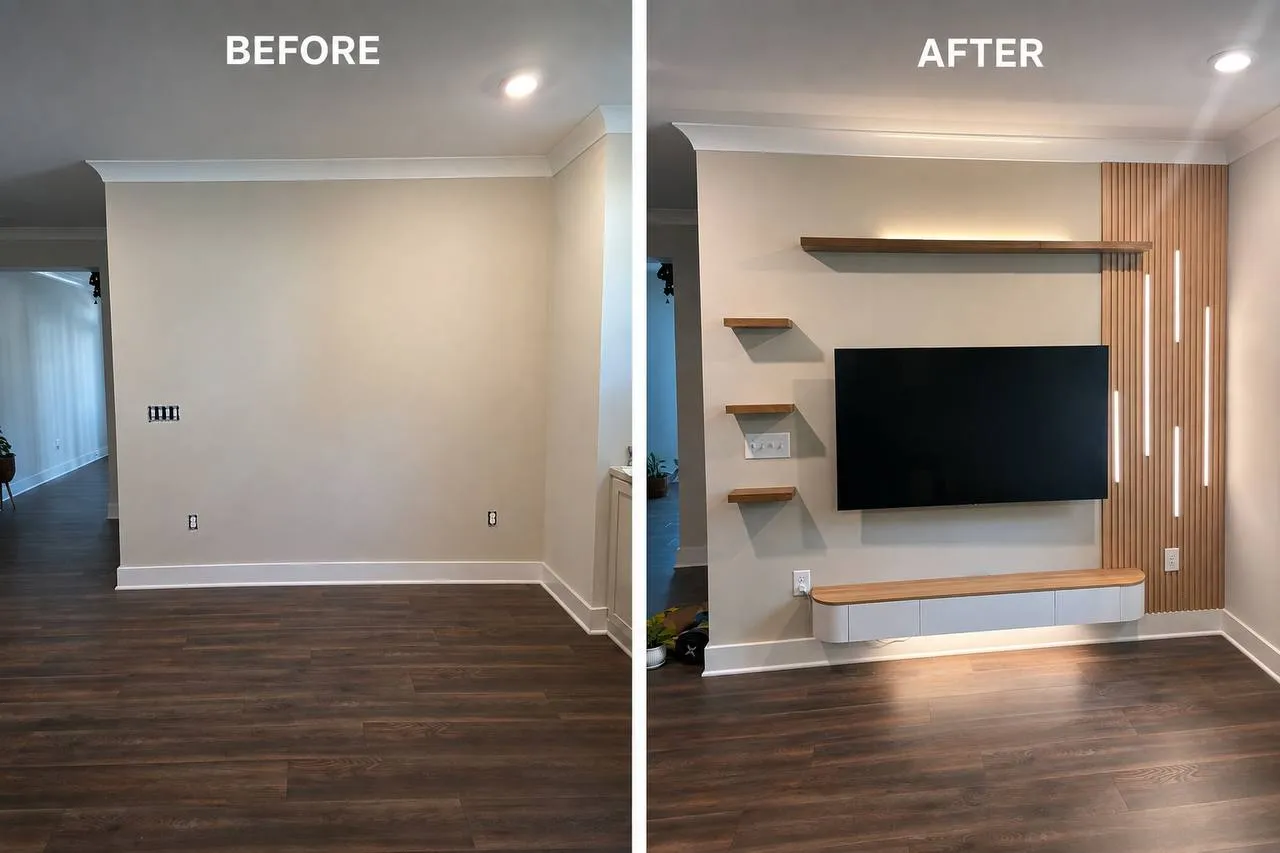
One blank wall turned into the focal point of the room: slat panelling, floating shelves, a floating cabinet and LED strips recessed into the panel.
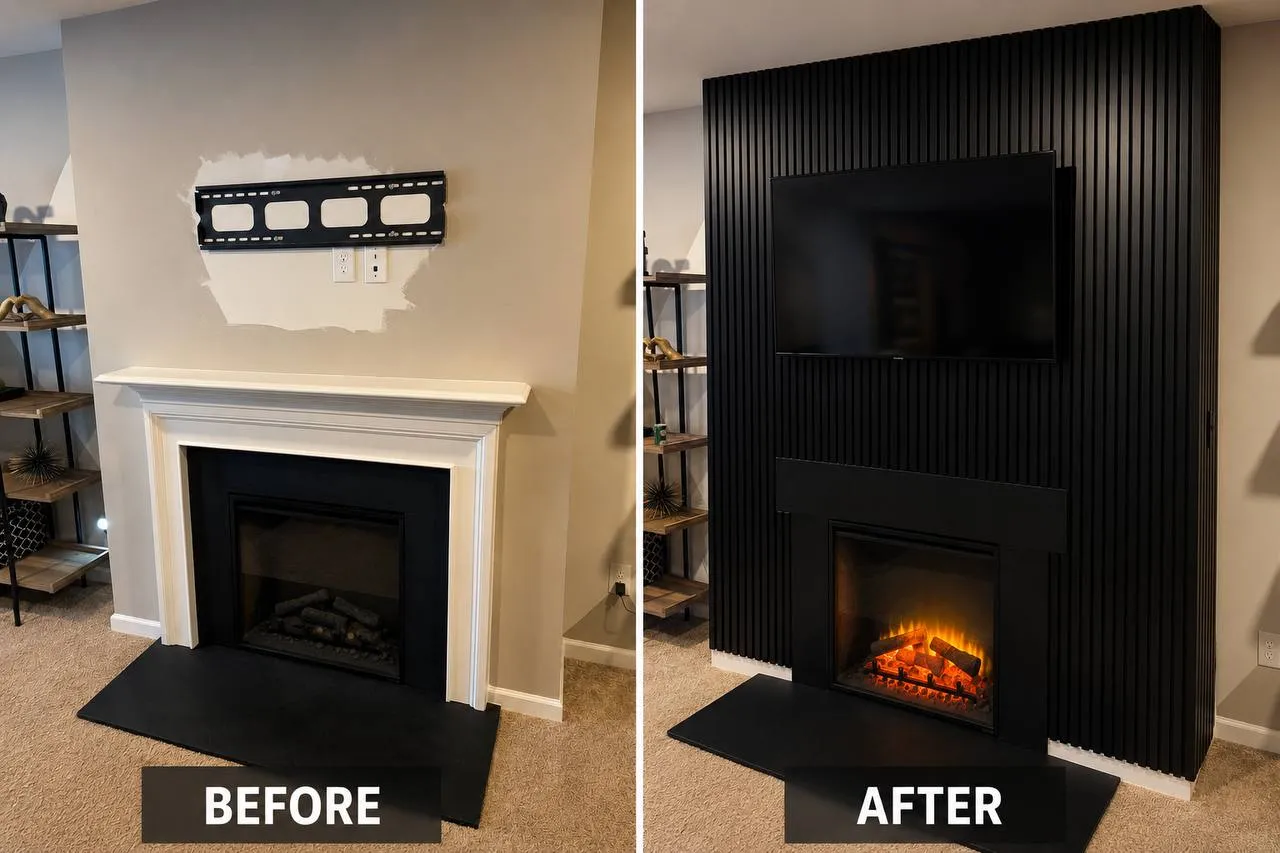
Fireplace surround rebuilt floor to ceiling in black slat, with the TV bracket and the new firebox set flush into the wall rather than hung on it.
Accent Walls in Raleigh — questions
Our walls are plaster, not drywall. Can you still build a feature wall?
Yes, and it is worth doing properly. Plaster does not hold fixings like drywall over studs does, so the framing gets located and fixed into actual structure, and any drummy or loose plaster in the working area is stabilised first. Building onto plaster that is already letting go of its lath just moves the problem.
We have original trim we do not want to lose. What happens to it?
It stays. In an older Raleigh room the trim is the best thing in it, and the feature wall is designed around it rather than over it. Panel proportions are set out to relate to the existing baseboard, picture rail and casing heights, which is what makes new moulding look original rather than applied.
Do you cover all of Raleigh?
Yes, including the east side out toward Knightdale and Wendell. It is around half an hour from Apex. A feature wall is a multi-day job anyway, so the drive matters far less here than it would for a single small repair.
How to get a price
- 01
Fill in the form
A sentence about the job and the address we would be coming to. Rough measurements help but are not essential — the address is the part we cannot work without.
- 02
Get a number
Most jobs are priced from the form without anyone driving out. Bigger projects get a short visit first, and the estimate is free either way.
- 03
Pick a time
The price is agreed before any work starts. We work 8am to 8pm, seven days a week, and take urgent jobs when we can.
Accent Walls in nearby towns
Free estimate
Tell us what needs doing.
Fill in the form with a sentence about the job and the address. You get a straight price and a real window back, usually the same day you ask.